Marigolds Lead You Home
In Tzintzuntzan, Mexico, the traditions of Día de Muertos allow two families - one indigenous, one American - to mourn, remember, and lead their loved ones home.
Text and photographs by Christopher Scott Carpenter
We push forward up the street, advancing slowly against the steady procession of people flowing toward the cemetery. I look at my mom; she is taken by the sight of the celebrants dancing with large wooden arches adorned with photographs and flowers and trailed by musicians with their trumpets and violins and guitars.
“Are those for family members who have died?” she asks as we watch one arch float past us in the river of people.
“Yes,” I reply. “Come, they’re just around the corner.”
The town of Tzintzuntzan sits tucked alongside Lake Pátzcuaro in the Mexican state of Michoacán, about five hours by car through the highlands west-northwest of Mexico City. This is my mom’s first time here to observe and celebrate Día de Muertos, or Day of Death; it is my second. I first traveled here in October 2021 - in the wake of the COVID-19 pandemic - to document the practices of this festival devoted to remembrance after so many families had contended with loss, much of it due to the virus, in the preceding year. This was when I met Luz Enid Cabrera Rivera, married name Estrada, whose home we are now slowly approaching.
We hear the singing before we see the doorway. A male voice warbles above the accompaniment of his band; this is música Purépecha, or the music of the indigenous Purépechan people who have lived in these highlands since pre-Hispanic times.
The main avenue branches off into a narrow residential street. The singing is loud now, the band exuberant. People pool outside a courtyard ahead of us, delivering food and flowers, hugging, chatting through both laughter and tears.
The voice of the singer is comforting and intoxicating. It draws us inside. He’s joined along one wall by a bassist, a guitarist, a violinist, and others; they play to the gathering family and friends. A dining table stretches inward along the opposite wall, banquet-style, dotted with bowls of salt and paprika and beers and plates of sliced limes. Farther inside I see the family’s ofrenda, or altar, bursting with color.
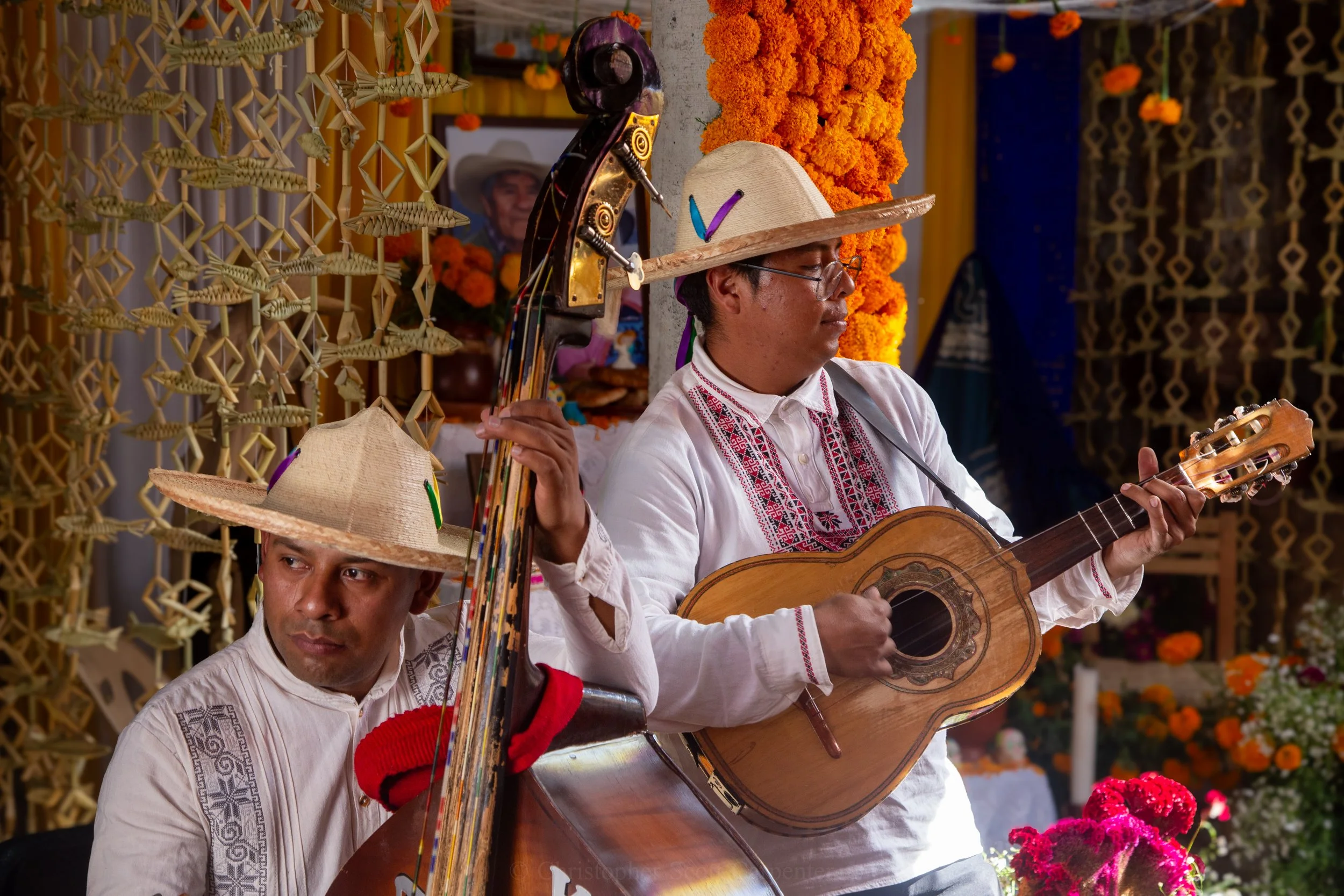
A band plays música Purépecha
I immediately spot Luz among those gathered, her Bronx accent unmistakable above the din of other voices - the same thing that caught my attention when she and I first met. I had no specific plan when I arrived in Mexico in 2021. In fact, I hadn’t even seriously entertained the option of going to Tzintzuntzan at all; it was someone I met on the plane who suggested it. And then upon nightfall I simply walked out the front door of the hotel and followed the energy, going where the people went. To my delight my ears eventually detected English - thick Bronx English - and from there the conversation flowed. Luz, originally from Puerto Rico, lived in New York City for decades before settling in Mexico to be with her husband’s family, with whom I held vigil in the cemetery late into the night. Today she looks the exact same as she did then, the softness of her face giving way to easy smiles, the same tooth still missing.
“Hello!” Luz calls. She’s assisting the family in the kitchen to supply the guests with a steady supply of churipo, a spicy beef stew. “Give me one second. I’m excited to meet your mom!”
I notice an open chair near the band. “Are you okay here?” I ask my mom, motioning to the chair. “Yes,” she confirms. “Go enjoy.”
I venture deeper into the courtyard. I step gently as people and emotions flow around me. Above me is a colorful array of decorations called papel picado, small pieces of tissue paper cut into intricate designs of skulls, animals, and flowers. They’re fluttering like butterflies across the ceiling, delicate reminders of the fragility of life.
Ever Estrada Cabrera, Luz’s son, however, does look different. A beard streaked with a flash of silver now frames a face that’s a bit wiser, a bit more weathered. He sees me and we collide in a full-hearted hug. He escorts me to the ofrenda, the altar inside the family home that sits as a centerpiece in the festival’s traditions, and he tells me about the elderly couple whose photograph I now stand before.

Juan Estrada Rendón and Mariana Guadalupe Aparicio Corral met, married, raised a family, and lived their entire lives in the community of Tzintzuntzan. In life they dedicated their time to producing traditional pottery fired in wood-fueled kilns, a craft passed down through the family for generations; and to raising cattle and cultivating corn and beans and chilacayote, a Mexican squash. They were proud members of a group known as Los Comuneros, practitioners of the cultural traditions of Tzintzuntzan and defenders of the community’s territorial rights.
Papa Juan and Mama Lupe, as Ever calls them, passed away within six months of each other, in March and then September. Inseparable in life, and near-inseparable in death.
I ask Ever to guide me through the altar and its symbolism. Ever, soft-spoken and gentle as always, tells me that altars are constructed with three tiers that symbolize the three parts of the cosmos - heaven, earth, and purgatory - and thus lay the path for the souls to travel. Atop the altar is a photograph that provides a sense of connection to those who have passed, a physical representation of the family’s collective memories and emotions attached to those depicted. Much of the rest of the altar is set in preparation for the return of spirits that night: clothing worn in life, favorite foods and drinks, traditional bread and candy sugar skulls.
Ever continues. In the Tzintzuntzan tradition a family will construct an archway - el arco - decorated with marigolds and other flowers, foods, and objects cherished by the deceased during their lifetime that will be paraded to the town cemetery - los arcos we saw floating down the street. The arches will be crowned with one, two, or three crosses - again, the symbolic cosmology of the number three - depending on how many years have elapsed since their passing. This arch, he points out, has one cross.
For the arch, Ever’s aunt Estela made beautiful embossed vases and a depiction of the Virgin of Guadalupe, a testament to the couple’s lifelong work in pottery, and Ever’s aunt Martha created two exquisite hummingbirds from feathers in honor of the definition of the Purépechan word Tzintzuntzan, meaning “the place of hummingbirds.”
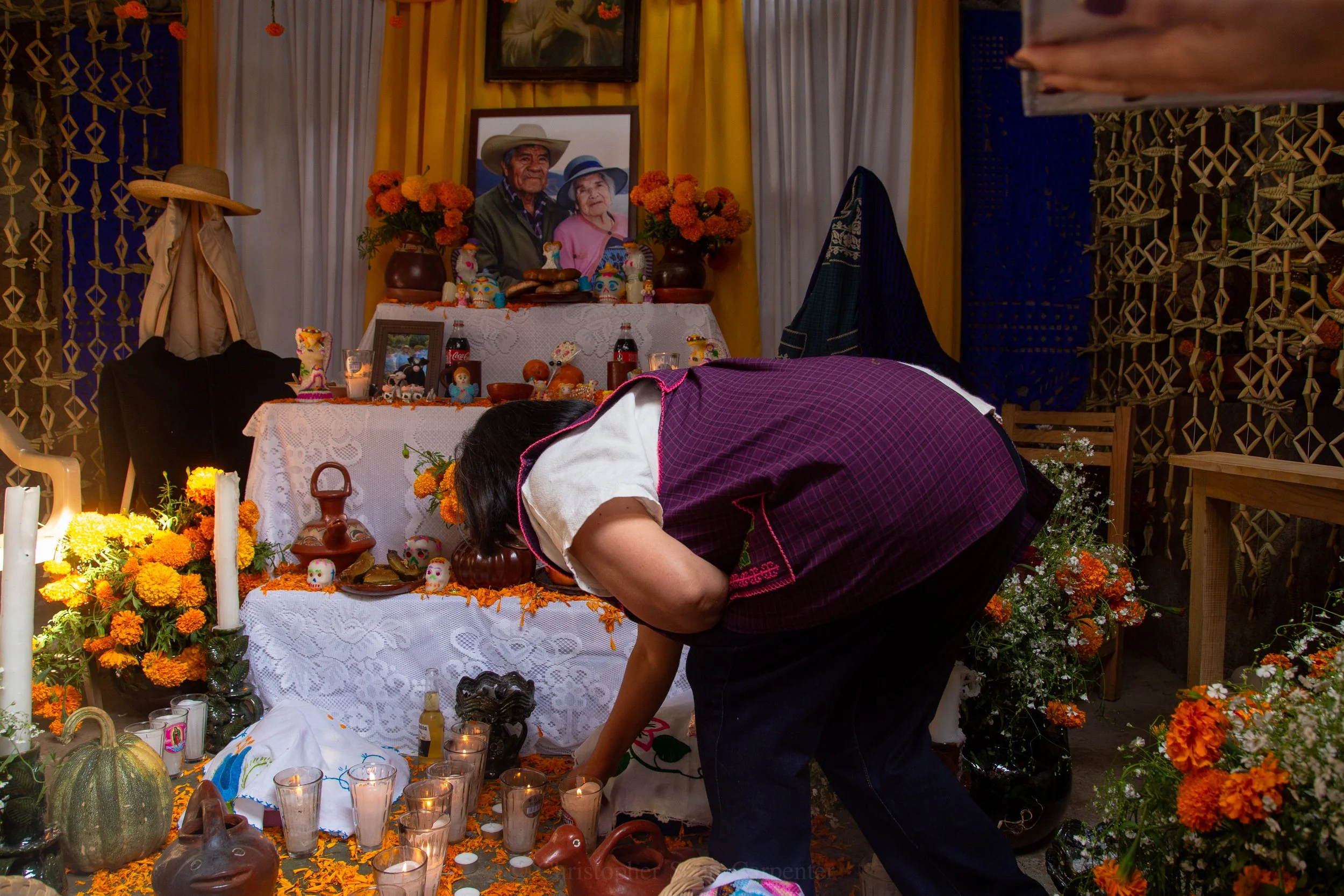
Sisters Estela and Martha tend to their parents’ altar
Martha, I learn, never married. Culturally, she was expected to remain with and care for her parents, and make the arrangements this Day of Death to welcome them back. It is Martha who will hold vigil the longest tonight, who will stay present until the dawn, until long after many others have returned home.
I feel a tug on my shirt. I turn around. A young boy asks with great interest if I’ve yet been served any of the stew. I tell him I haven’t had any yet, but that I would be thankful if he made his way over to the table near the band, to my mom where she is seated, to see if she’s had some. “Who’s your mom?” the boy inquires. I glance in her direction; I see Luz has made her way over to my mom, and they’re locked into the kind of conversation only two mothers can achieve. I point, and the boy, clearly energized in his capacity as server, hustles to the kitchen. Along the way a woman rubs his head, tussling his hair. It takes me a moment, but I eventually place her in my memory. This is Ever’s sister Bernadette, whose husband died in 2021, his arch adorned with one cross. And I realize why I almost didn’t recognize her - she’d been pregnant with her second child at that time; her first child, now four years older, is the one eagerly serving guests stew.
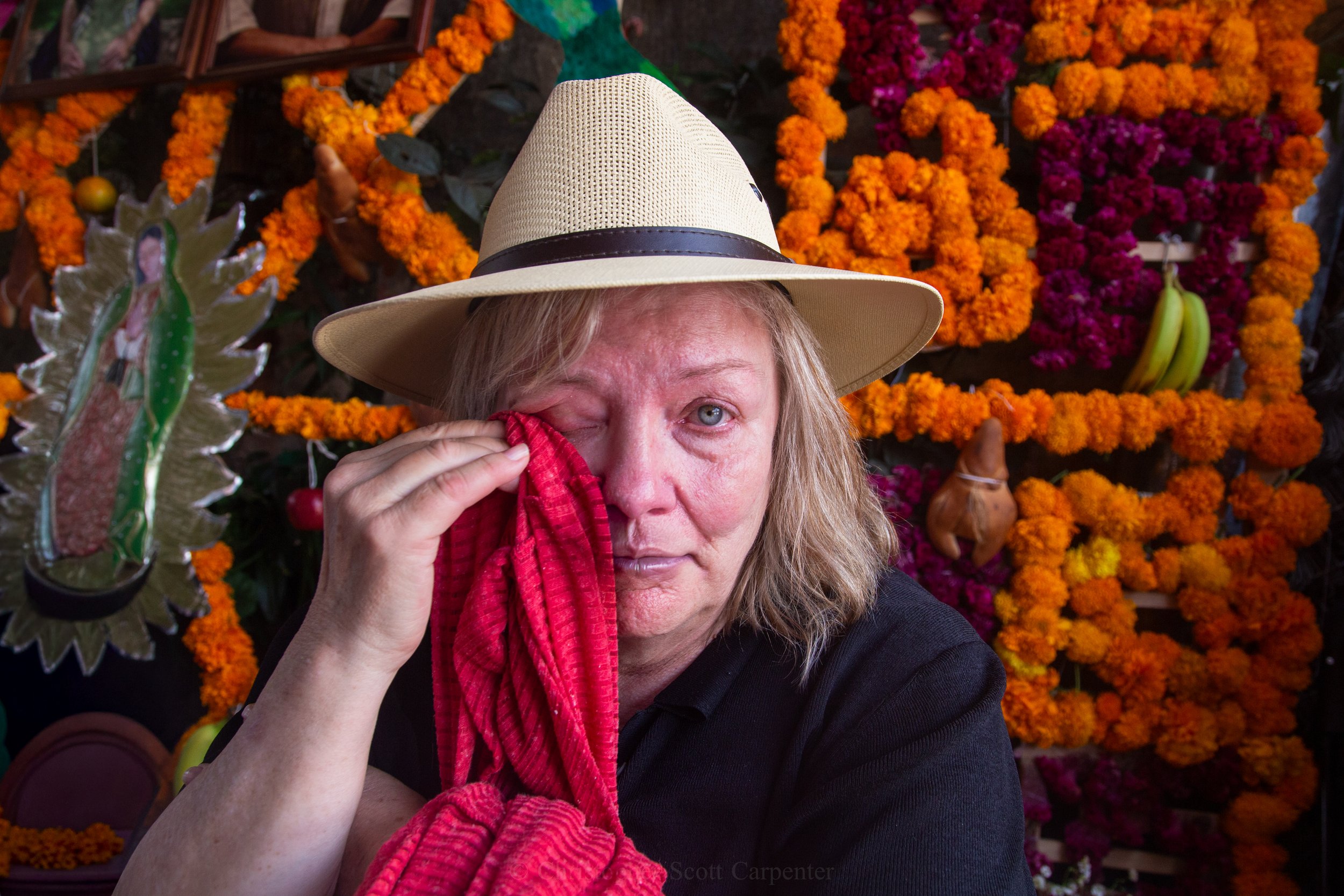
Grief is a fundamental human experience. It transcends country, class, and creed. Stick around this life long enough and you will lose someone. That’s just how it is. And the combined loss of two parents reminded my mom of losing her own.
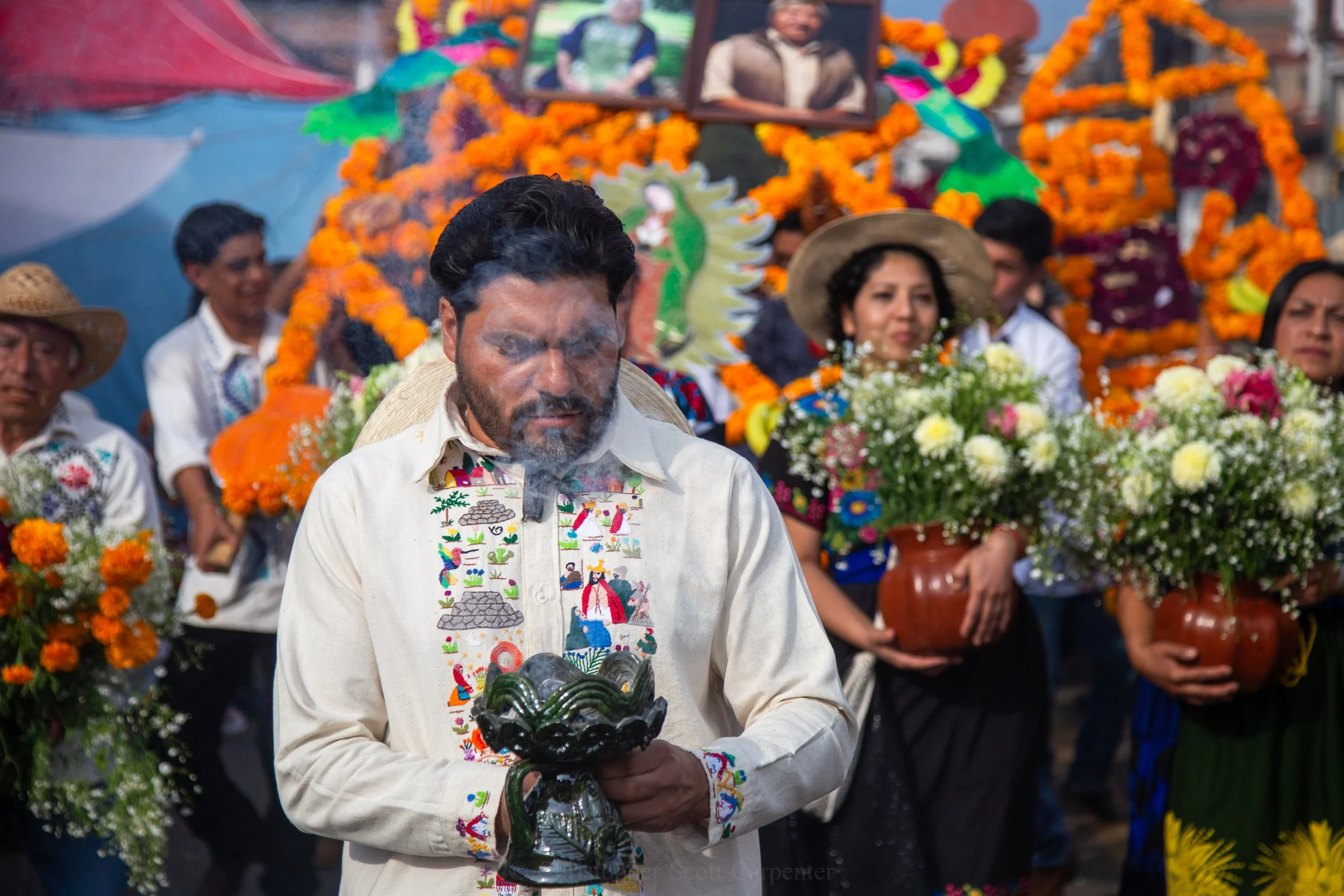
Ever leads his family’s Día de Muertos procession
Suddenly, it was time to take the arches to the cemetery. Ever leads the way, gentle in his movements, carrying an incense burner whose purifying smoke transforms into prayers for Mama Lupe and Papa Juan, and whose unmistakable scent starts guiding them home.
The boys of the family hold the arches aloft, dancing in festive circles as we parade down the street. Others hold beautiful vases bursting with flowers. The band plays música Purépecha, soundtrack to a soulful journey.
Luz and my mom walk together, keeping to the back of the crowd.
“I was like a son to them,” Ever tells me when I catch up to him on the street. “They raised me with beautiful morals. Love for family. Respect. Indigenous identity. Responsibility. Spirituality.” He pauses to reignite the incense. The smoke is thick, the scent strong.
“They are returning to tend the eternal love they planted in our hearts.”
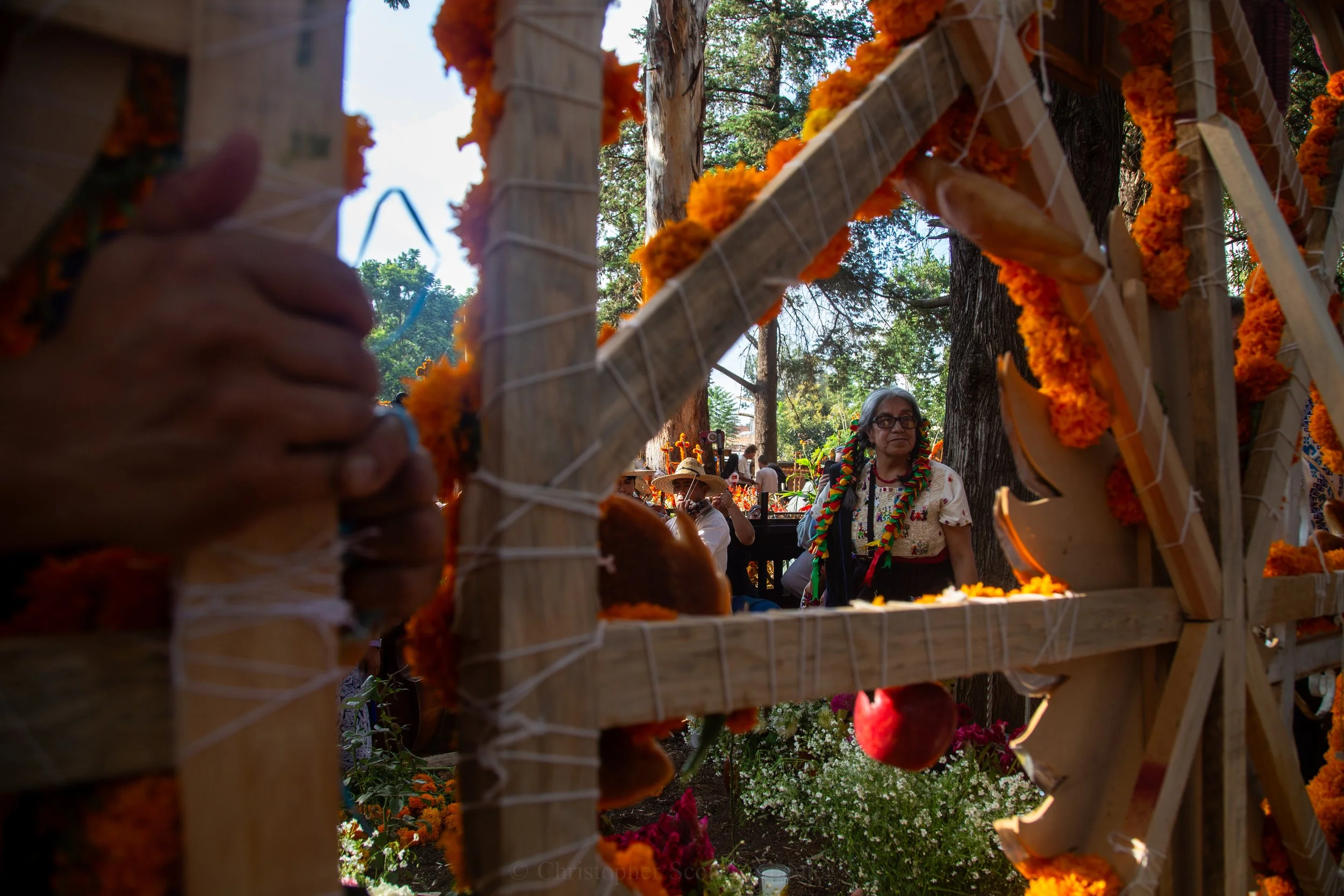
Martha directs family members in preparing the archway
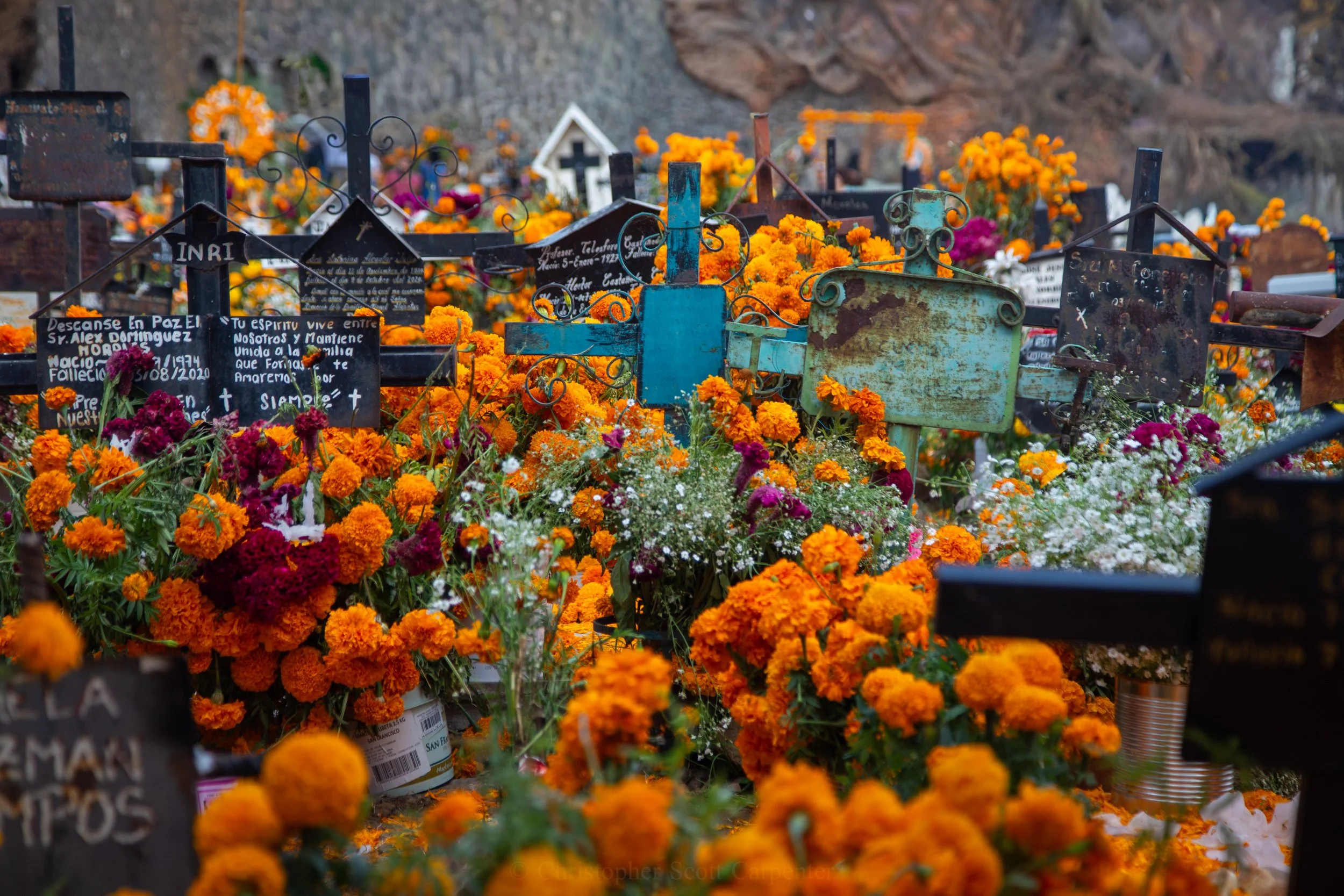
The cemetery teems with activity, with families making preparations. Arches are erected above gravestones. Marigold flowers are loaded in by the bunch. I see one man carrying so many at once that only his legs are visible underneath.
Martha takes charge of the operation, directing family members on what to clean and where to place offerings. The arch for Papa Juan and Mama Lupe rises into the air, standing over a family plot now embellished with candles both short and tall, picnic baskets full of bread and fruit, and flowers.
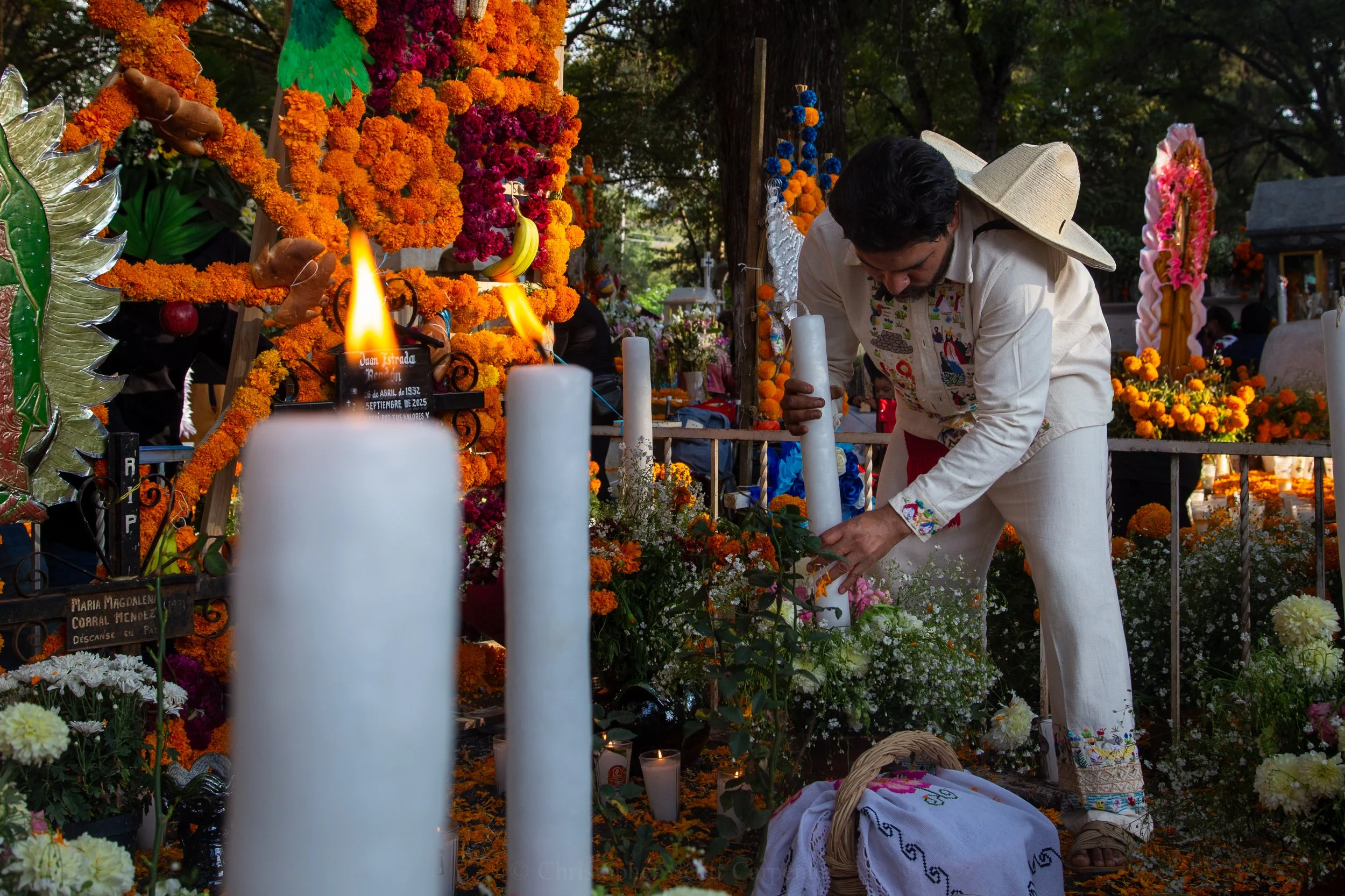
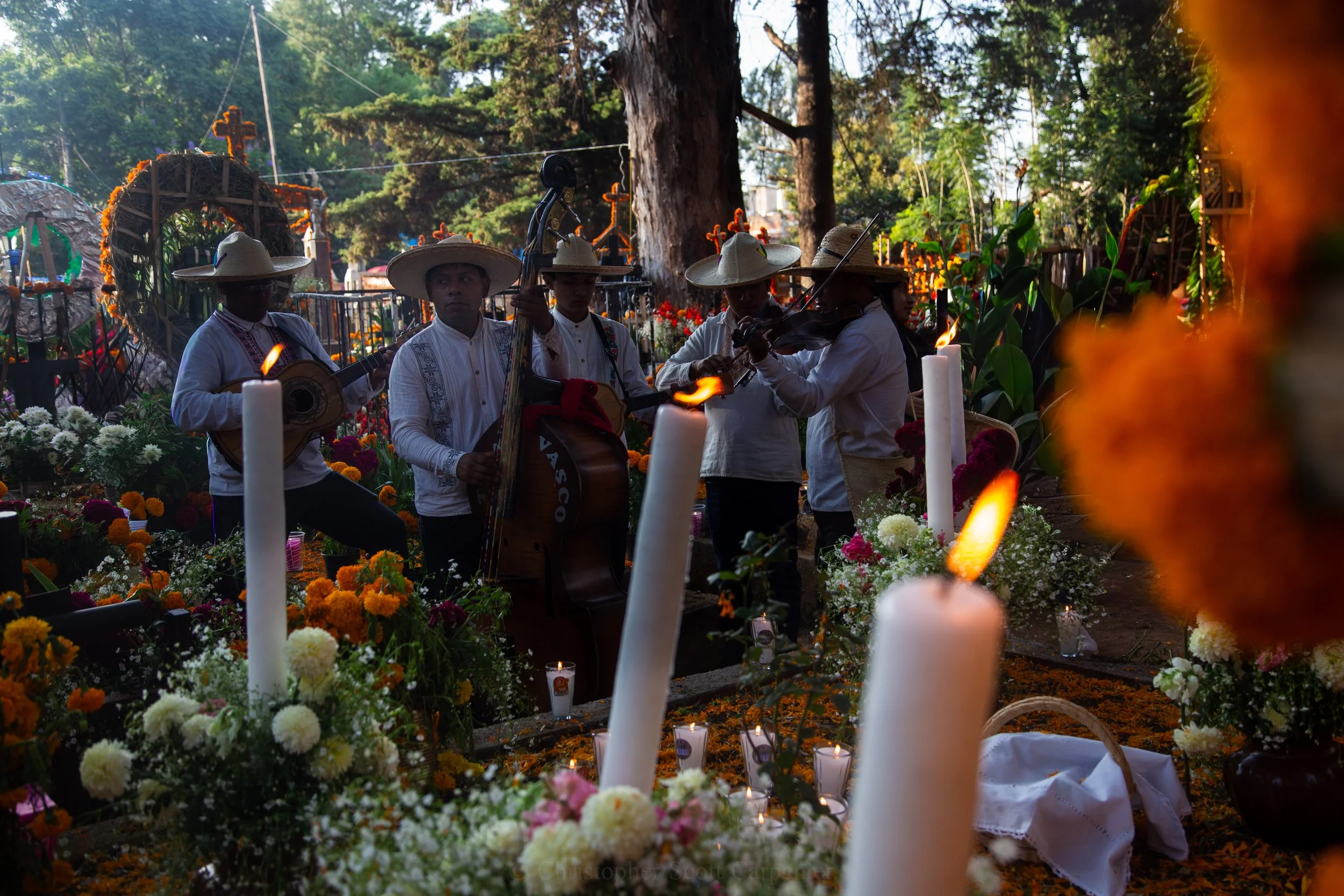
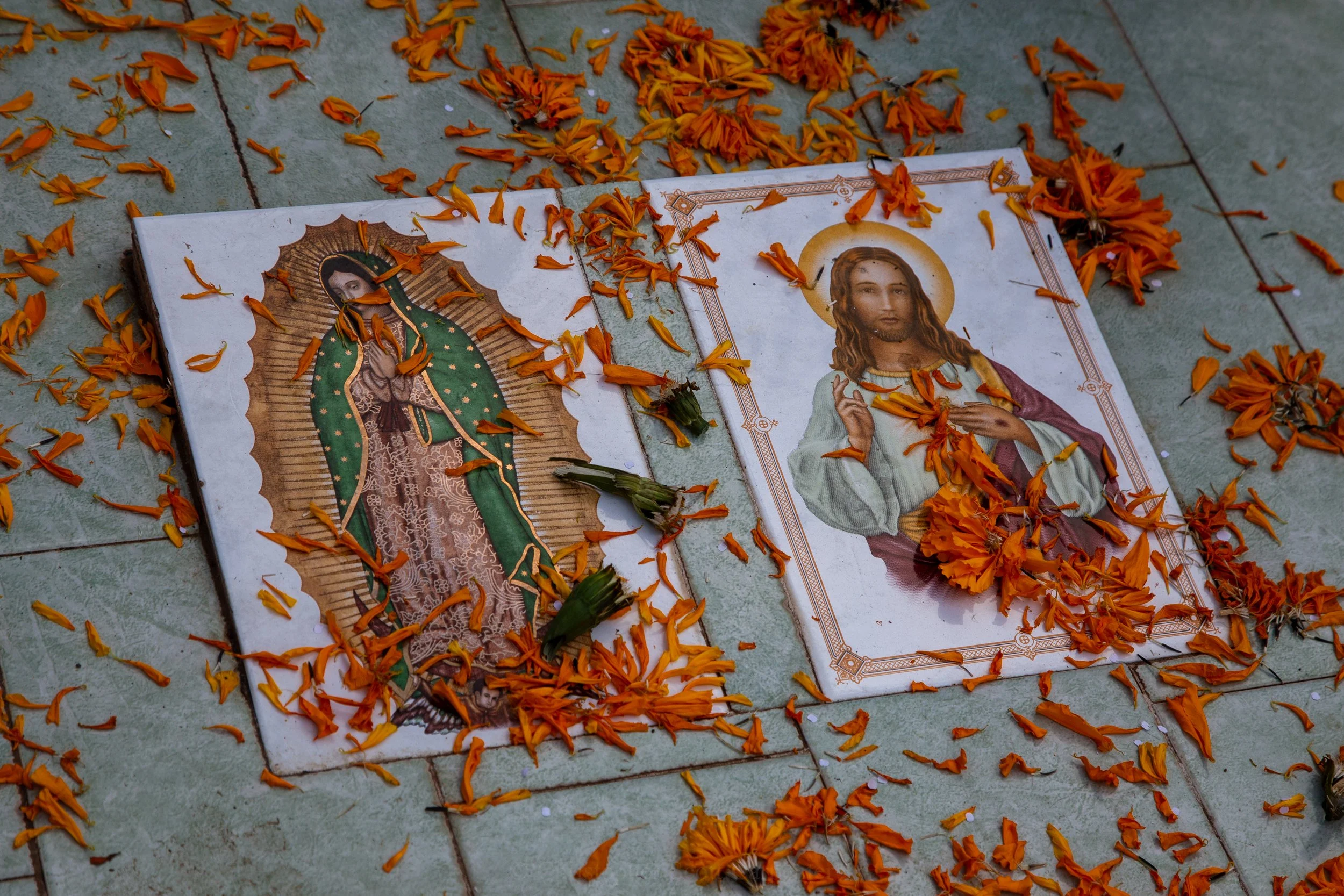
To the ancient Aztecs, marigolds represented life. The vibrant hues of the flower were symbolic of the power of the life-giving sun, with its warm, radiant light and cyclical reliability. When honoring the dead the Aztecs would line their homes and altars with the flower, believing the bright colors and pungent earthy odor helped guide departed souls through the treacherous darkness to Mictlan, the realm of the dead - and then back again.
After Spanish colonists arrived and Catholicism seeped across the land, spiritual practices were forced to change. We see this hybrid today in the cemeteries of Mexico; though now draped across the crosses of Christianity, the marigold has remained, a symbol as eternal as the sun and as certain as death.
Night eventually falls.
Kay Hugh Spackman and Beverly Ann Van Cott met, married, raised a family, and lived their entire lives in the state of Utah. In life, Beverly was a passionate grade school teacher, one who committed herself to earning respect from her students, rather than demanding it. Not once in her long career, she was always proud to say, did she raise her voice in anger. In life, Kay owned an advertising agency, and worked with some of the most prominent newspapers in the state at the time. He loved sports, and coached his own two sons through a national professional tennis circuit. In the later part of his life he wore, damn-near every day, a sweater embroidered with various sports’ balls. They were proud members of a supper club that would meet once a month, and steadfastly ensured a big family party every Christmas Eve.
My mom was incredibly close with her parents - her dad Kay absolutely, but her mom Beverly especially - and found the grief nearly unbearable after Beverly passed away in 2008. It’s the beautiful burden of love that if someone comes to occupy your heart, it means someday an equal amount will be torn away. So my mom started clinging to what she’d lost, since the physical body was no longer there to touch. For months she kept a pair of her mom’s pajamas near her side of the bed, a ready piece of familiarity if the sadness every grew too heavy. She wore her jewelry and collected every photograph that could be found. To this day, a picture of my grandmother can be found tucked inside the sleeve of my mom’s passport cover.
On occasion, my mom will takes notes and small items to her parents’ shared gravesite, reminders - like a sportsman’s golf ball or a teacher’s old lesson plan - for the deceased of a life lived.
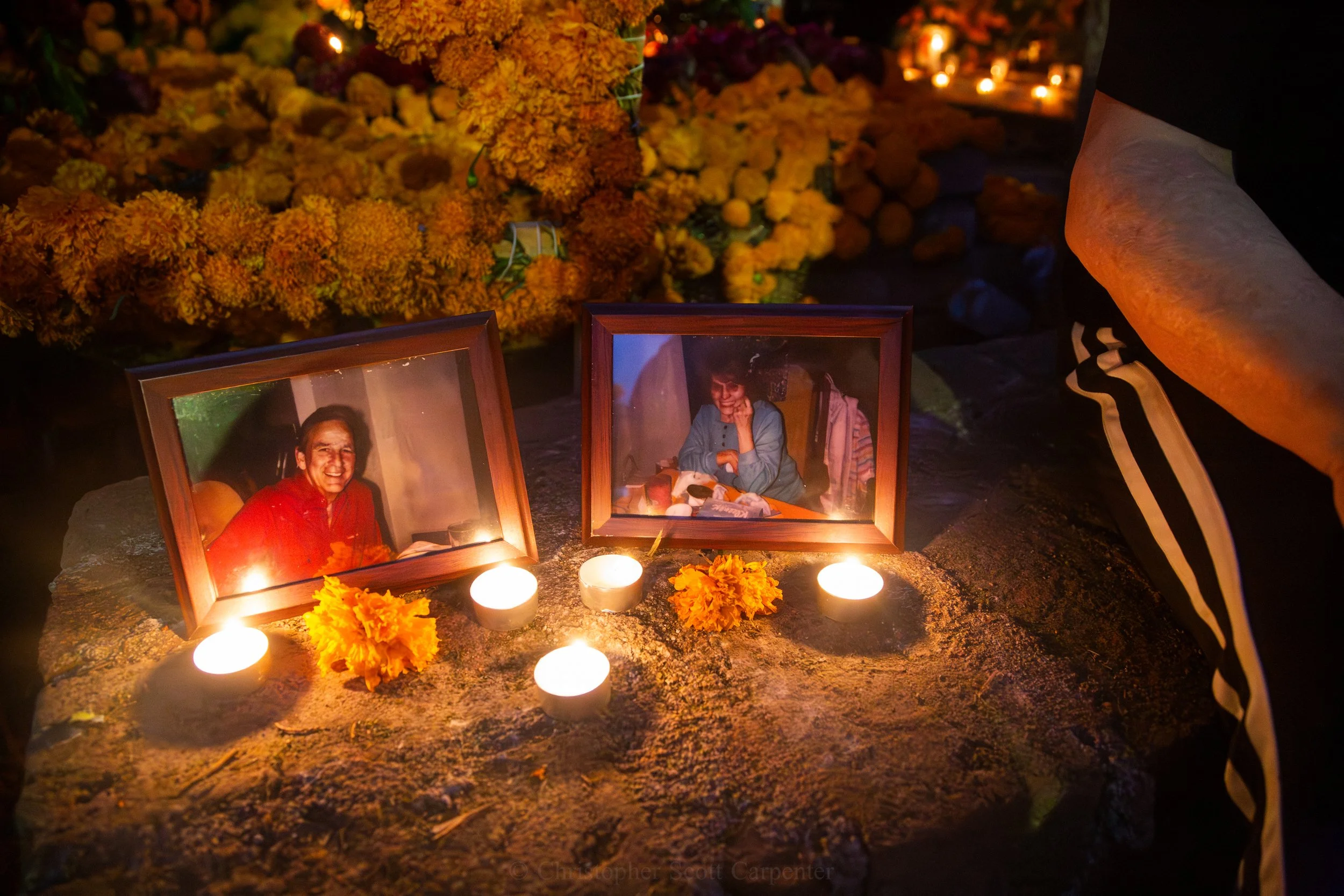
Central to the planning of this mother-son trip was the creation a small makeshift altar to allow for grief and memory to, perhaps, be experienced in a new way. So, in a quiet corner of the cemetery nestled between monolithic gravestones and arches bursting with marigolds, my mom and I assemble it with photos of Beverly and Kay. We light candles and place a few marigolds of our own. Nearby, a woman tending her family’s gravesite notices our activity. I hesitate, thinking our informal display was being perceived as an encroachment on a sacred space. But the woman nods approvingly, and continues with her work. The more the merrier, it seems.
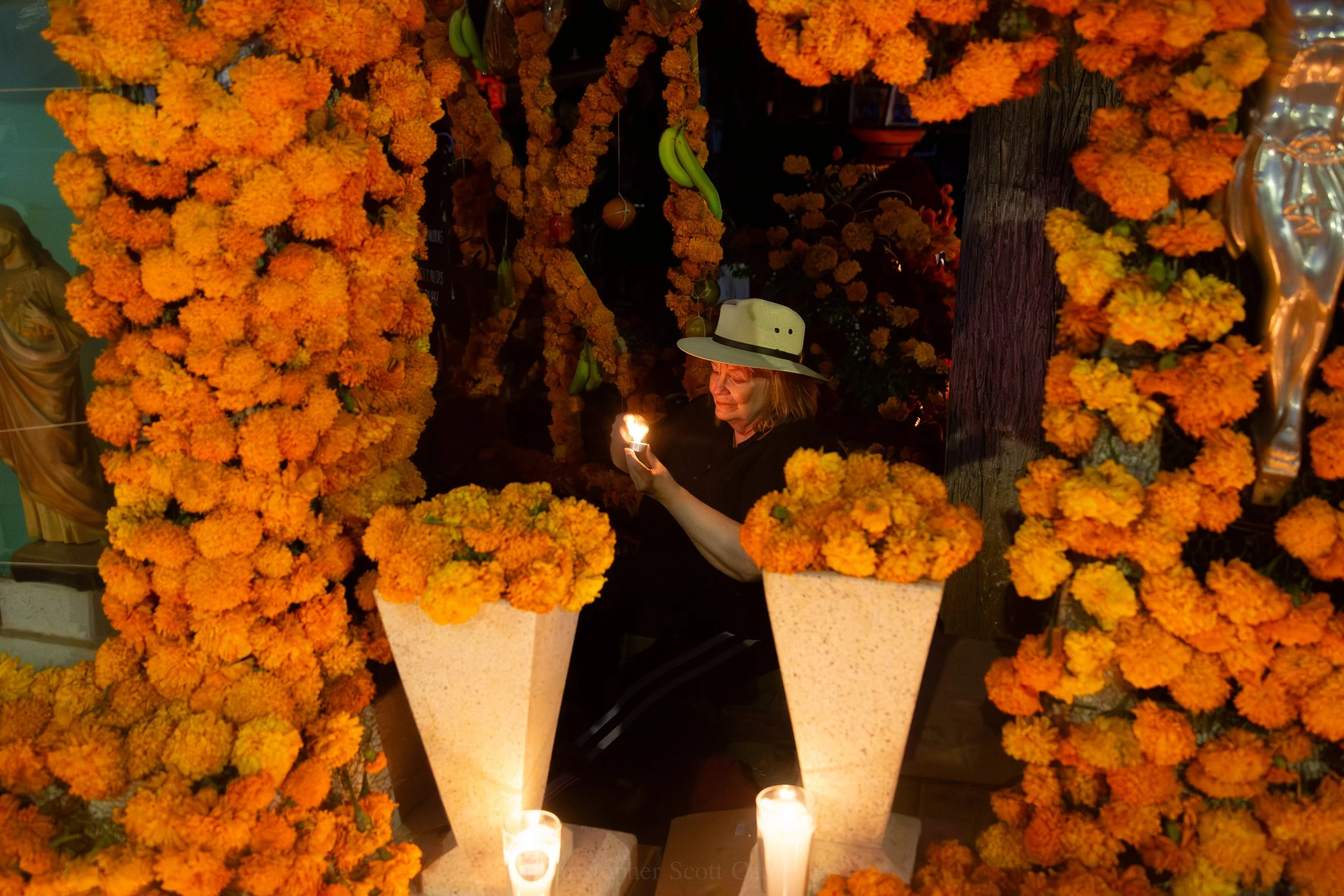
With my mom now settled at our makeshift altar, I slink through the crowds toward the other side of the cemetery, retracing my steps from memory to revisit the graves from my visit four years prior.
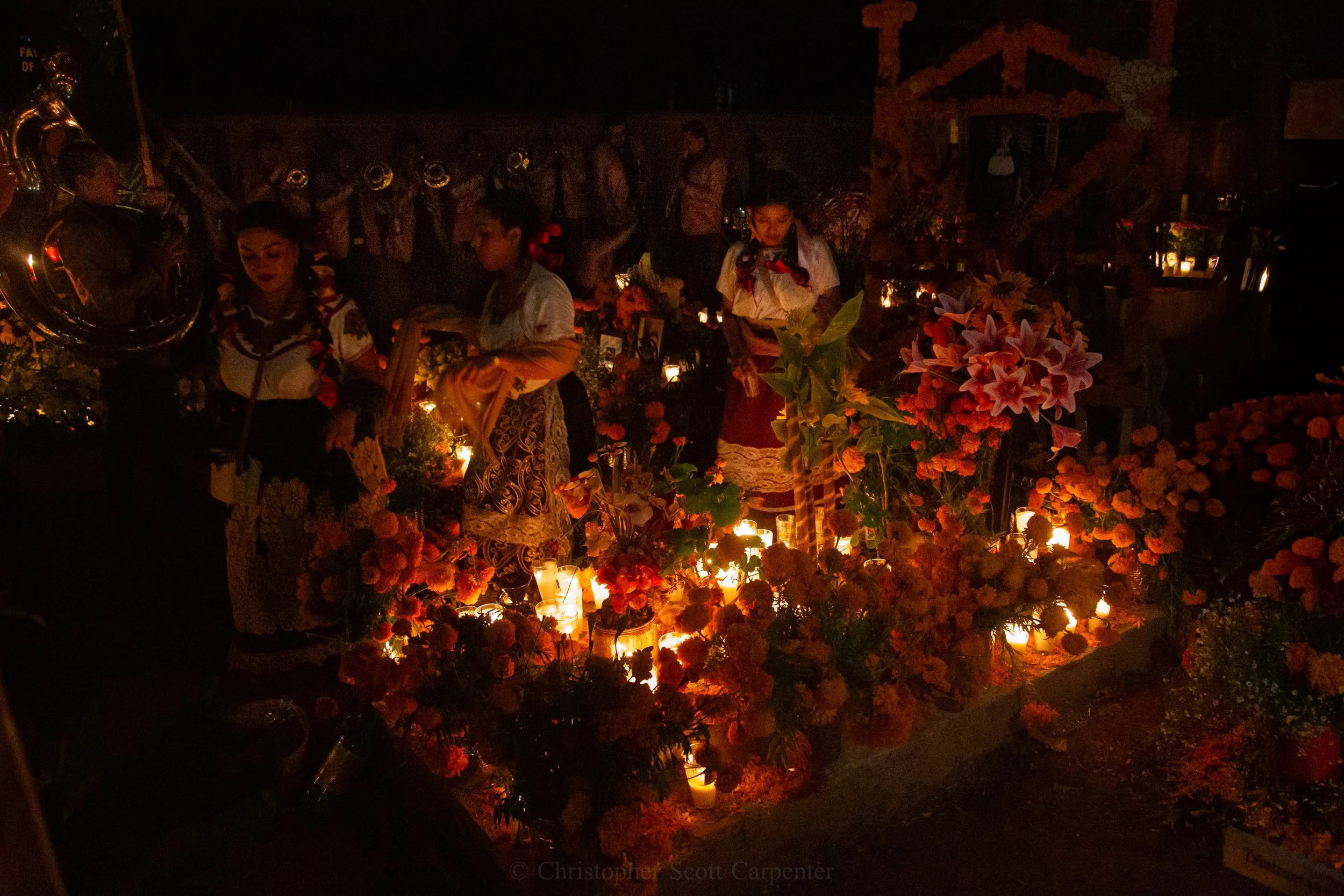
A common cemetery scene during Día de Muertos
It is dreamlike to walk through a cemetery expecting the return of souls. Darkness envelops the world, interrupted only by flickering orange candles that have settled on the land like radiant snowfall. In the logic of dreams, beyond the cemetery - beyond the edge of the candlelight - is an abyss. From corners indistinct comes música Purépecha, bittersweet wails of brass instruments that, although lamenting loss, also cherish reunion. The exhaustion and alcohol evoke a delirium akin to weightlessness; the feeling of being out of one’s body, of being a journeying soul.
José Manuel Campos Aparicio was 40 years old when he died in 2021 from complications of COVID-19. In life, he was a police officer in Tzintzuntzan, a job he loved. I remember his nightstick and uniform featuring prominently on his arco, tucked gingerly alongside his favorite drinks and foods. During the overnight vigil in the cemetery it was pointed out that near José’s grave was one of a teenage girl who tragically committed suicide. In the soft candlelight we speculated that José, the beloved policeman, maintained his duties even in death, and protected her as they made their journey that night.
The current image of José’s gravesite contrasts starkly with what I remember: the intricate display of his arch lined with marigolds, fruits, and bread; the family members encircling the grave, sharing food and drinks and conversation; the brilliant display of candles; the band playing his spirit home. Tonight he rests in soft darkness. The potent warmth of grief fades, as it always does, into the somber shadows of memory.
While the family’s efforts may be concentrated on the arch for Mama Lupe and Papa Juan, that doesn’t mean José is forgotten. I soon see Bernadette draped in a shawl and trailed by her two sons. She drifts toward me between the headstones. In her arms are the candles, flowers, and foods for a display that, while a little more intimate this year, is still dedicated to her husband’s return, a duty maintained by a widow.
“You know, I was pregnant the last time you were here,” she says. Her younger son, now four year old, was born shortly after his father’s soul had first been welcomed back, meaning she had to contend with a pregnancy alongside her husband’s illness and death. The boy now hides behind his mother’s leg, as young kids are known to do.
“I’ll be honest, I almost didn’t recognize you earlier,” I say. I pull my cell phone out of my pack to locate the series of photographs I’d made four years ago, a way to reconnect over that shared experience. I scroll through candlelit scenes from the cemetery; portraits of Luz and of Bernadette who, indeed, is noticeably pregnant; and, perhaps most importantly, photographs of José’s altar inside the family’s home.

Bernadette’s older son Christian - the dutiful stew server - becomes animated at the sight. He points at the screen, at an image of Luz and Ever lighting candles, and looks at me. “Was this the altar for my dad?” Christian, who had been only four years old himself when his father passed away, has since experienced half of his entire life. He was too young to appreciate or even acknowledge the ways in which his father was honored by his family, how they adorned his altar with his police uniform and baton, how they held vigil all night to welcome his spirit home.
Photographs are memories made manifest. Photographs of deceased relatives are crucial when observing Día de Muertos because they capture more than a likeness - they capture an essence, all the abstract intangibles returned, through the simple act of looking at a photograph of a loved one, to the hearts of those left in the Land of the Living. I realize Christian never saw the photographs I took - I suppose there’s no reason why he would have, given he was only a small child at the time - and that his eagerness for me to send them along means something essential will be returned to him. Christian now has memories he wouldn’t have remembered, and his younger brother now has memories he couldn’t have even made in the first place.
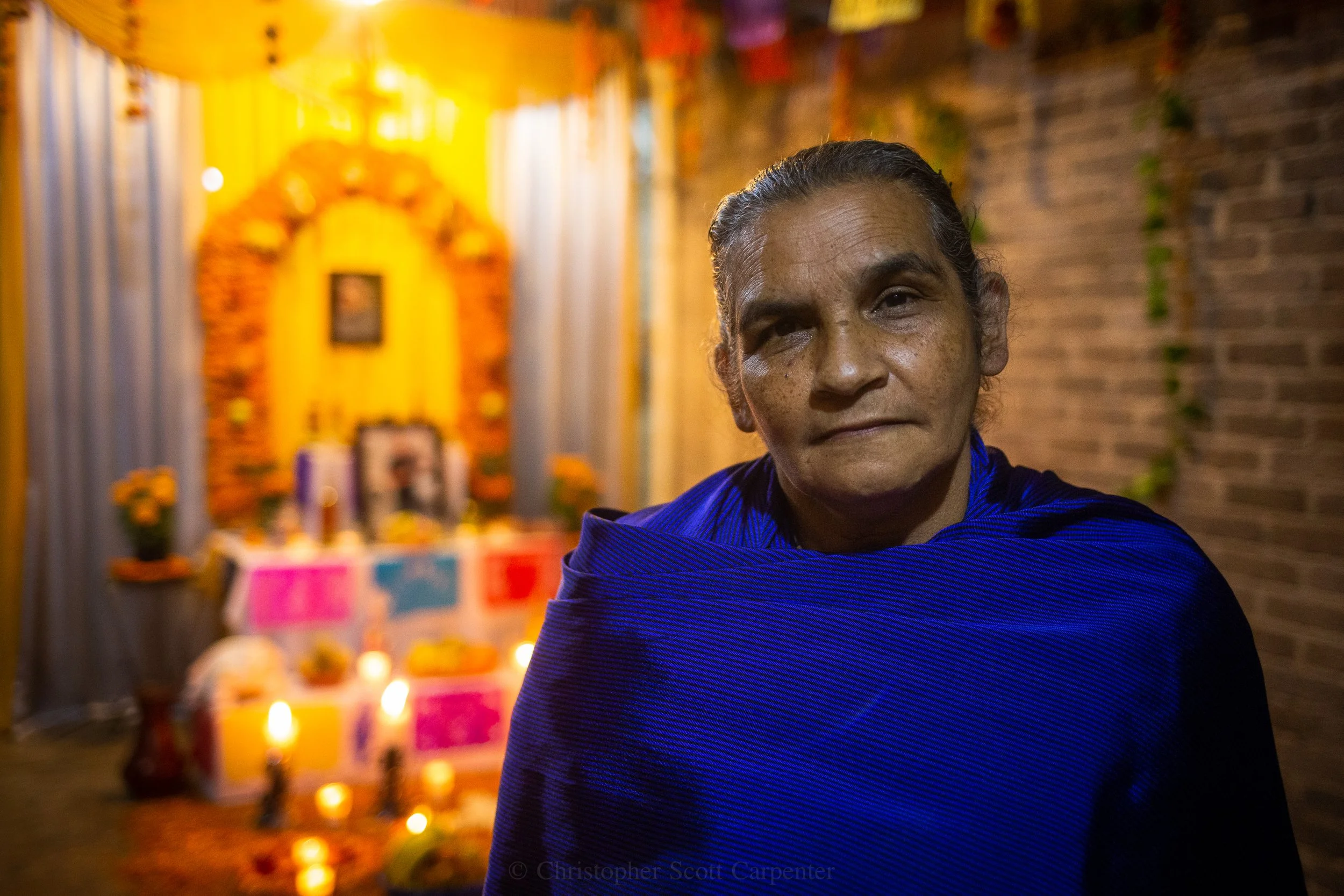
Luz at home in front of José’s altar
My mom looks up at me as I return, then turns to watch a flame dwindle on a candle’s wick. “You know, now that I am here and have seen what this is like, with all the flowers,” she says, “I remember that, when we were kids, we used to plant marigolds with grandma and grandpa outside our house.”
It’s late now, well past midnight. With the moon gone from the sky, we pack up the photographs and leave, too.
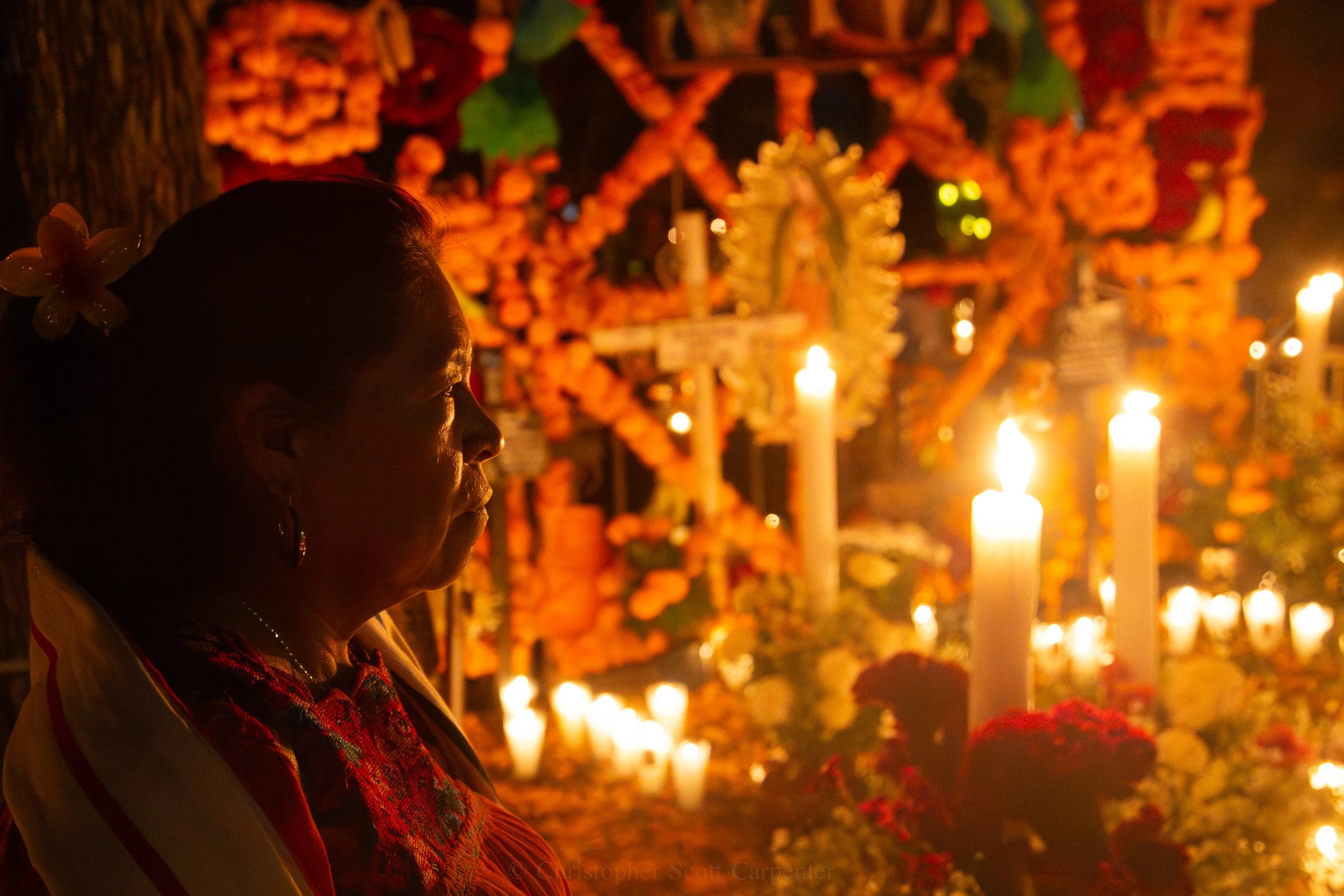
Sister Estela keeps vigil late into the night
Since returning to the United States, little has changed. I don’t know if being immersed for a night in that candlelit landscape transformed how my mom handles grief, how she moves through memories. She still on occasion leaves the same notes and small gifts for her parents - things like golf balls, or old lesson plans. It’s the best she can do, and has been doing it all along.
We do plan to return to Tzintzuntzan, though, to see our friends - both living, and dead.

A woman dressed as la Calavera Catrina, “the Dapper Skull,” a Mexican folk icon